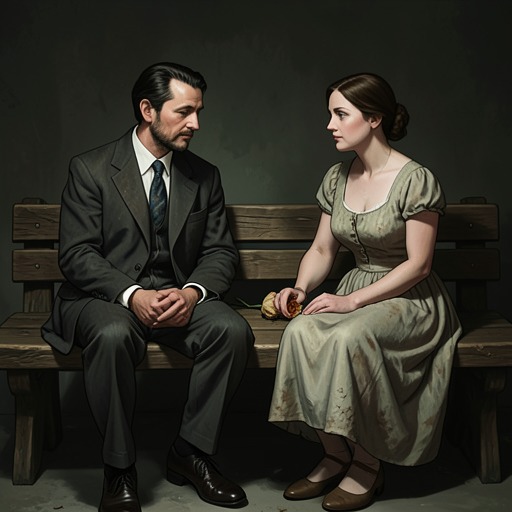
Russ McCoy's proposal to Nadine
The Journey CollectionRuss McCoy's proposal to Nadine is a turning-point family event in which grief gives way to a deliberate second beginning. Russ does not treat his love for Nadine as a betrayal of Loralie McCoy; instead, the proposal shows him accepting that remembrance and happiness can coexist. Its emotional force comes from Travis McCoy's approval, which transforms Russ's decision from a solitary act of recovery into a step recognized by the family he is trying to preserve.
Causes and Emotional Background
Russ's proposal follows the death of Loralie McCoy and the long period in which he remained attached to her memory. When Travis asks whether it is acceptable to move on, he frames the issue not as replacing Loralie but as refusing to let grief define the rest of Russ's life. Travis recalls that Loralie would not have wanted Russ to grieve forever, and Russ acknowledges that he intends to propose to Nadine. The decision therefore grows from mourning, but it is also enabled by the surviving family's recognition that love can continue after loss.
The conversation also reveals that Russ and Nadine's bond has become substantial rather than merely consoling. Travis says that he likes Nadine, that she treats Max as her own, and that she is good for Russ. Russ adds that Nadine loves Travis McCoy, Penelope Stone, and Max, describing them as her family as well. Her place in the household is thus established through care and mutual attachment before the formal engagement occurs. The proposal gives an existing emotional reality a new social name.
The Proposal and Its Timing
Russ does not announce an exact plan or date for asking Nadine. He says that he will know when the time is right, making the proposal a decision grounded in emotional readiness rather than ceremony or pressure. He also asks whether Travis will be comfortable with it, which exposes the continuing importance of his son's judgment. Travis answers that he is, even while admitting that he misses Loralie every day. His consent carries the weight of reconciliation: father and son can speak about Loralie without treating sorrow as a prohibition against future happiness.
The proposal itself is later recalled as having taken place on Christmas morning. Travis McCoy, Penelope Stone, and Max are opening presents when Russ and Nadine burst into the house. Nadine extends her hand to display a small, oval-shaped diamond ring on her left ring finger, making the engagement visible through a precise, intimate object. The surprise is not only the announcement but its timing: Russ moves from uncertainty about when to act to a decisive public declaration during a family holiday.
Family Witness and Consequences
Russ's happiness is intensified by Travis's immediate response. Travis stands and hugs his father, and the sight of Russ's joy amazes him. The embrace confirms that Russ has taken a major step away from widowhood without losing his son's loyalty. Travis understands that Russ is allowing himself to be happy, and although the speed of the change surprises him, he is glad that Nadine is there to care for his father.
The engagement also changes the structure of the wider family. Because Nadine already treats Max as her own and regards Travis McCoy and Penelope Stone as family, her marriage to Russ will formalize an already functioning network of support. The event occurs alongside other family transitions: Travis intends to make Max's legal surname McCoy before marrying Penelope Stone, and the couple later includes Max in their wedding ceremony by having him help light the eternity candle. Against that pattern, Russ's proposal is another ritual conversion of affection into recognized family membership.
Marriage and Narrative Significance
The engagement leads to a practical choice about the wedding. Since Russ and Nadine have both already experienced large weddings, they choose to marry in Red River rather than repeat that scale. Travis McCoy, Penelope Stone, and Max travel there to witness the ceremony, turning the marriage into a shared family occasion rather than an isolated romantic event. The proposal therefore initiates not merely a couple's future but a communal act of acceptance.
Narratively, Russ's proposal mirrors Travis McCoy's own later proposal to Penelope Stone. Travis kneels before Penelope, offers a black velvet box, and asks her to marry him; she answers yes through tears. Russ's engagement uses a different presentation, with Nadine revealing the ring at Christmas, yet both moments make love legible through a ring, a spoken commitment, and the presence or approval of family. The parallel links two generations and two forms of second chance: Travis repairs the relationship he once abandoned, while Russ learns to love again after bereavement.
The event's decisive value shift is from permitted grief to shared hope. Russ remains connected to Loralie McCoy, but his proposal demonstrates that fidelity to the dead need not require permanent emotional isolation. By asking Nadine to become his wife, and by receiving Travis McCoy's blessing, Russ re-enters family life as someone capable of both remembering and beginning again. The proposal consequently supports the book's larger movement from separation and loss toward reconciliation, marriage, and an enlarged family future.